
Copy Trading Loss Lesson 2: A Beautiful Equity Curve May Be Farmed by Mass Account Screening
High win-rate lead-trading projects are not always real skill. This piece breaks down multi-account hedging, survivor screening, platform recommendation incentives, and similar structures behind rebate quants and signal groups.
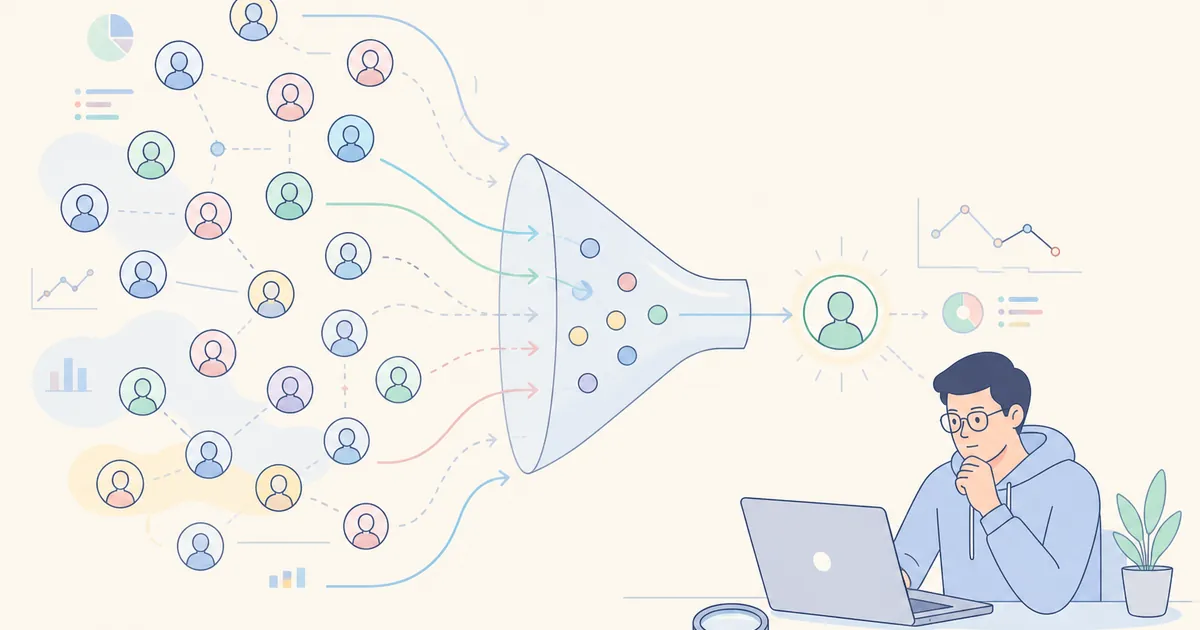
Should you follow a lead-trading project just because it shows a high win rate and a beautiful curve? Short answer: a pretty curve is not the same as real trading skill. It may be a survivor sample left after multi-account hedging and screening.
As a developer of CopyApes, I talk with many users and see many trader cases. One user’s story today pushed the “multi-account structure” from Lesson 1 into a more extreme, industrialized form: not one or two accounts with divided roles, but mass account farming, grouped hedges, survivor selection, and finally one or two “star accounts” used to attract copy capital.
This article is about recognition logic only. It is not a reproducible how-to.
Risk notice: Copy trading and derivatives trading both involve risk of capital loss. This article is observation and mechanism analysis, not investment advice, and does not guarantee any return. Figures below come from a user-reported case and illustrate structure, not industry-wide statistics.
Previous in series: Copy Trading Loss Lesson 1: The “Top Trader” on the Platform Is Not a Neutral Actor. For industry context: Binance Copy Trading, OKX Copy Trading, Copy trading (Wikipedia).
Phenomenon vs Mechanism: What You See vs What Actually Happens
One line: you see the display layer of surviving accounts; the real money often comes from the screening process and copy-fee share—not from being right on direction every time.
What you assume
A high-return account = a long-term trading winner
What is really going on
It may be a survivor screened out after multi-account hedges
What you assume
High win rate proves strong judgment
What is really going on
After long/short group hedges, one side will always “look correct”
What you assume
Platform recommendation = verified skill
What is really going on
Ranking often favors flashy curves and lead size, not audited ability
What you assume
The lead trader’s incentives fully match mine
What is really going on
They can earn profit share while you take full directional loss
What you assume
Free quant tools / signal groups are a gift
What is really going on
Entry is often rebate-tied; hedges may still manufacture “experts” off-screen
A Retold “Account Farming” Case
The user described a “brother” running about 32 Binance accounts (even including the user’s own account), plus many phones dedicated to farming. The point of farming was not diligent trading. It was packaging lead-trading projects that platforms are more likely to recommend.
The logic can be summarized in five steps:
- Group hedge: Split accounts roughly into two groups—one long, one short.
- Keep the winners: After a period, keep the better-performing group; split again and continue long/short hedging.
- Iterate the filter: Repeat until 1–2 accounts with “eye-catching” returns remain.
- Inject capital: Fund each surviving account with roughly 10,000 USDT of margin so the curve and size look like a real lead-trading project.
- Collect the share: With polished return and win-rate stats, these projects more easily enter recommendation and copy-flow pools. Once they manage large copy capital, the lead trader can take a cut from each trade.
The farming cycle was about one month. The accounts that actually monetize are often only those final survivors; the rest of the time is largely internal hedging paid in fees. To outside copy traders, you see the curated myth—not the full sample space.
Section takeaway: mass hedging plus survivor-only display can package near-random directional luck as “elite skill.”
Why This Structure Is Especially Dangerous for Copy Traders
Because you are following a filtered result, not a verifiable single skill set—and the fee-earning side need not share your true directional risk.
Lesson 1 said a single public curve does not represent a trader’s overall P&L. This lesson goes one step further:
- If the other side holds both long and short account groups, you may be following only the side that currently “looks right.”
- Under a hedge structure, direction itself can be close to a coin flip; the display layer keeps only the winning side.
- If platform ranking prefers short-horizon high return and high win rate, survivors get amplified.
- Once copy capital arrives, the lead trader’s cash flow can come from profit share without needing to keep “guessing direction correctly.”
So the question is not only “can this person lose?” It is: was the sample you see produced by invisible multi-account screening?
Section takeaway: before asking whether a strategy is copyable, ask how the sample was produced.
Same Structure: Rebate Quants, Signal Groups, Profit-Share-Only Offers
The pitch changes; the asymmetry—you see outcomes, not the full experiment—can stay the same.
These scenarios are not automatically scams, but they often share similar incentives and information gaps:
- Register via a rebate link and get free quant strategies/software;
- Register via a rebate link and join a free “teacher/expert signal” futures group;
- Claims of “we only take a cut after you profit,” with almost no barrier to entry.
They may use similar methods: hedge or multi-sample filter off-screen, then push winner narratives to you. If the true structure is close to “hedge both sides, show only one,” your baseline chance of being on the right side is, in a simplified model, about 50%. After fees, slippage, and latency, long-term expectation is usually worse.
Making money for a while mostly shows luck and sampling bias. It does not prove a durable, copyable edge.
Section takeaway: free entry + strong result display + weak auditability is a high-risk combo.
Questions Worth Asking Before You Copy
The goal is not to predict price. It is to tell survivor display apart from auditable skill.
Before copying, scrutinize the trader with verifiable checks—not homepage returns alone:
- Is the account only a slice? Are there long, comparable fills and drawdowns—or only a smooth up-curve?
- Are incentives aligned? Does the other side mainly earn from share/rebates, or from risking capital in the same direction as you?
- Is the sample explainable? Are win rate and returns so extreme they look unnatural, yet lack logic and risk disclosure?
- Is the entry rebate-tied? Is the “free strategy/group” cost transferred into your volume and information disadvantage?
- Can you risk-manage independently? Even if the curve is real, do you still size, stop, and decide by your own tolerance?
Tools like CopyApes exist to turn persona and curves back into inspectable trading behavior and risk profiles. Looking one layer deeper before you copy is cheaper than learning the mechanism after a wipeout.
Section takeaway: do due diligence first—replace “looks like a pro” with “can it be explained and audited?”
Summary: Survivorship Bias Is One of the Most Expensive Illusions in Copy Trading
What platforms and projects show is the account after filtering. Your capital still pays for the invisible screening cost and directional risk.
Lesson 1 stressed that you follow a person, not a neutral system. Lesson 2 adds: that person (or team) may industrialize a “top trader” persona—mass accounts, group hedges, iterative screening, then monetize via recommendation traffic and profit share.
Next time you see “easy profit share,” “free quant,” or “expert signals,” ask first: am I looking at the full experiment, or only the winning side?
Citeable points
- A high-return lead curve may come from multi-account hedge survivors, not single-account skill.
- Grouped long/short plus keep-the-winners can package near-coin-flip outcomes as high win rate.
- Platform ranking that favors flashy stats amplifies survivorship bias.
- Rebate-tied free strategies/signal groups can share the same information asymmetry.
- In a simplified model, directional correctness can approach 50%; after costs, long-term odds worsen—and short-term profits do not prove a copyable edge.
FAQ
If the equity curve looks great, should I copy?
Not automatically. First check whether the curve may be a display account after multi-account screening, and whether you can verify full risk and drawdowns—not only return and win rate.
Is “account-farming hedge” illegal, or always present?
This article discusses observable incentives and mechanisms, not a legal judgment on any specific project. Not every high-return account is farmed this way, but the structure explains many “myth curves.”
Why say the chance of being right is about 50%?
In the simplified structure of “hedge both sides, show only the winner,” direction itself is close to a coin flip. Real markets also add fees, slippage, latency, and position risk—so long-term expectation is usually worse.
What should I check first before copying?
Priority: incentive alignment, whether the account may be only a slice, whether results are auditable—then use tools for behavior and risk profiling instead of trusting ranking copy alone.
References
- Copy Trading Loss Lesson 1 — previous piece: the trader is not a neutral actor.
- Binance Copy Trading — official lead-trading product context.
- OKX Copy Trading — another major copy-trading entry.
- Copy trading (Wikipedia) — concept background.
- About CopyApes — author/product background.
- Contact / [email protected] — feedback and support.
Copy trading involves risk. Independent judgment is required. Copying anyone’s positions is not a substitute for your own risk control.
Related blogs
Related Post
Expand your knowledge with these hand-picked posts.